

Extra lens implant
Nearsightedness, farsightedness and astigmatism can be corrected by inserting an extra lens in front of your natural lens. With this procedure, you can see clearly again without glasses or contact lenses.
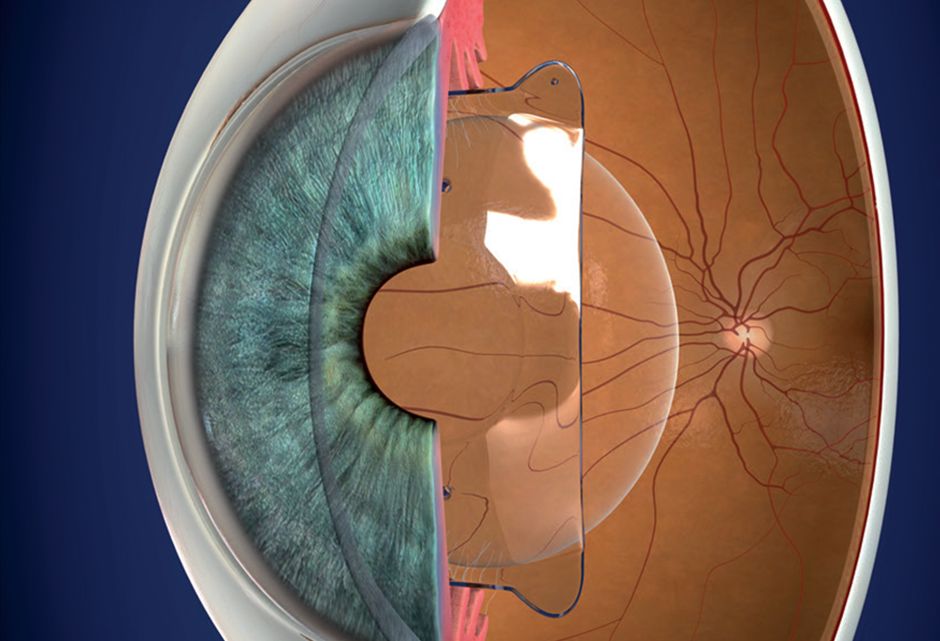
In this procedure, we implant an extra lens in your eye, without treating or removing your own lens. The new lens, known as an Implantable Contact Lens (ICL), or when your eye has a cylindrical divergence, a Toric Implantable Contact Lens (TICL), creates a sort of dome over your natural lens. The extra lenses are not visible to you or anyone else and are very well tolerated.
When are you eligible for an extra lens implant?
- Vision specifications
Nearsightedness (from -0.5 to -20 dioptres), farsightedness (from +0.5 to +10.0 dioptres) or astigmatism (from 0.5 to 6.0 dioptres) can be corrected with an extra lens implant.
The implant of an ICL or TICL offers an effective and safe alternative for patients who are not eligible for laser treatment, for example if the correction needed is too high or if the cornea is too thin or irregular.
- Age
To be eligible for the implant of an extra lens as an alternative to glasses or contact lenses, you must be between the ages of 18 and 45.
- Recent intake examination
The intake exam used as the basis for your treatment must not have been carried out more than six months before the actual procedure.
We’re happy to help!
Your vision, your comfort, your happiness: this is what we care about at Oogartsencentrum ZW-Vlaanderen and Kortrijk-West. Our experienced team is ready to help you and answer all your questions.
Start your process towards a life without glasses today, and schedule an extensive pre-operative exam and an initial conversation to get to know you (+/- 1 hour), so that together we can determine the best solution for you.
- After your intake exam, the lenses will be custom-made for your eyes. When your eyes have a cylindrical divergence, we will opt for a toric lens.
- Three days before the procedure, you will need to apply some preparatory eye drops at home.
- One hour before the scheduled procedure, you have to start applying eye drops at home to dilate your pupils, based on the instructions you are given during the consultation.
- When you arrive at Oogartsencentrum ZW-Vlaanderen, we start with a few administrative tasks. Once your pupils are sufficiently dilated, we will accompany you to the operating room. There, your eyes will be anaesthetised and carefully disinfected.
- While you lie back comfortably, we will insert the artificial lens via a small incision in your eye. After inserting the artificial lens, it will automatically take on the right shape.
- The procedure takes fifteen minutes per eye and is nearly painless.
The price of an extra lens implant varies, depending on various individual factors. We consider it important to make a personal price calculation for each patient. For an overview of our fees, please go to the fees page.
Frequently Asked Questions
What are lens implants and how does a lens implant work?
A lens implant, also called an ICL, is an additional lens that we place between your iris and your own natural eye lens. Your own lens stays completely in place. Through a small opening of 2.2 mm, we insert the folded lens into the eye, where it unfolds automatically. The body does not reject this lens, because the flexible material is recognised as the body’s own.
Is a lens implant possible with dry eyes and from what age can a lens implantation be performed?
Certainly. Precisely when laser eye surgery is not advisable — for example with dry eyes or a cornea that is too thin — a lens implant often offers an excellent solution. Your own natural eye lens is fully preserved. The minimum age for this procedure is 18.
Is it better to choose laser eye surgery or a lens implantation?
That depends on the characteristics of your eyes. A lens implantation comes into consideration when laser treatment is not possible, for example because your cornea is too thin or because you suffer from dry eyes. The advantage of an ICL is that your natural eye lens remains untouched. Which procedure is right for you will be determined by an extensive preliminary examination of about two hours.
How much does a lens implantation cost and is the operation painful?
The procedure is completely painless and takes about ten minutes per eye. We use local anaesthesia in drop form, so no needles are involved. Any follow-up treatment during the first year is covered by the guarantee. Health insurance funds and hospitalisation insurance policies sometimes reimburse the treatment partially or in full.
What should you avoid after a lens implantation and what is the recovery like?
One day after the procedure, you can usually already see 80%. Reading, watching TV and light work are possible right away. For three weeks, avoid rubbing your eyes, do not wear make-up and do not lift anything heavy. Swimming and sauna visits are not allowed during that period. Contact sports should be avoided for a full month.