

Conical cornea (Keratoconus)
What is keratoconus?
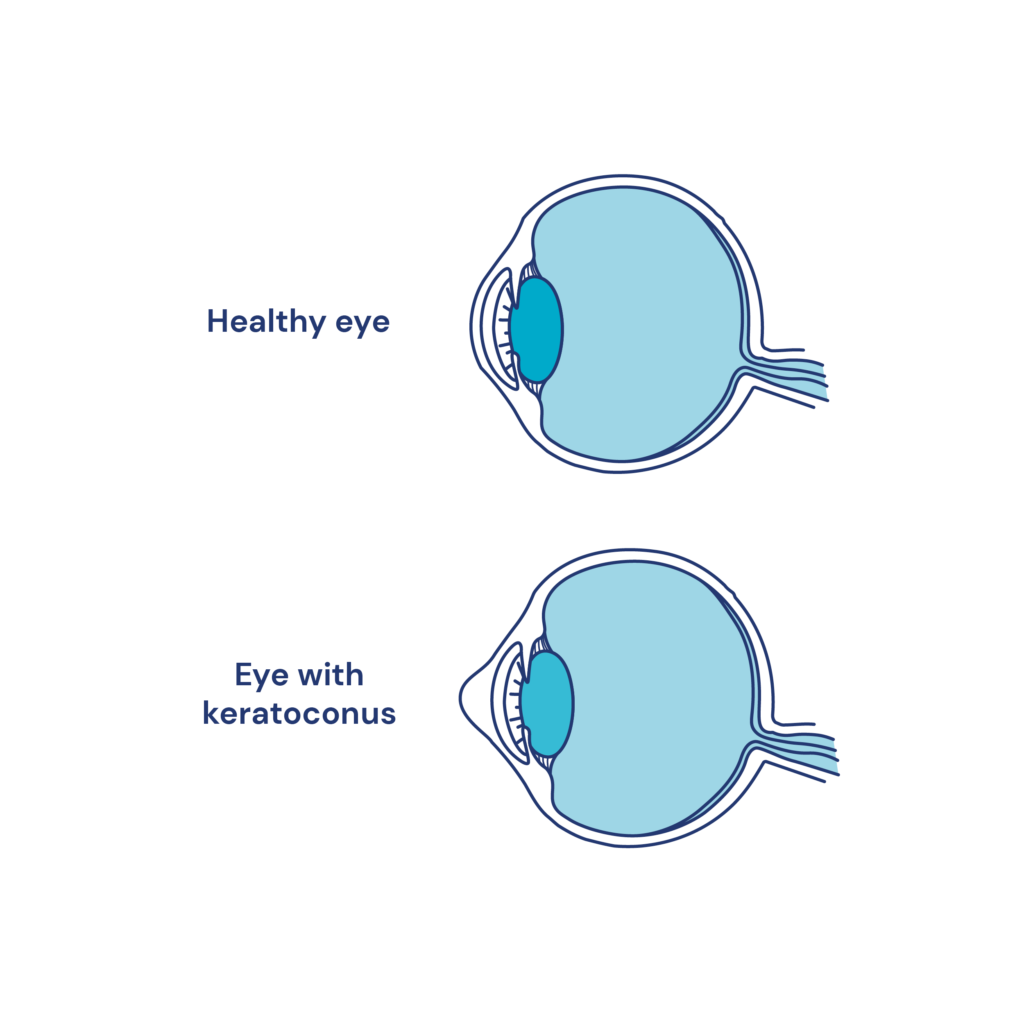
Keratoconus is an eye condition that affects the cornea, which becomes deformed. The cornea is the transparent, outermost part of the eye. Normally, the cornea is round. In the case of keratoconus, the structure of the cornea weakens, and therefore it loses its roundness and becomes more conical in shape. Because of this gradual deformation, the cornea thins and visual acuity decreases. In extreme cases, the cornea may even become cloudy and tear.
Symptoms of keratoconus
- Distorted vision
- Light sensitivity
- Light scattering
- Astigmatism
- Possible nearsightedness (objects or people at a distance appear fuzzy)
- Seeing a ‘fog’ (at an advanced stage)
Treatment of keratoconus
The diagnosis is made by carrying out various tests. The aim of the tests is, on the one hand, to correctly assess the irregularity of the cornea, and on the other hand, to carefully monitor the progression of the condition over time. The tests check what glasses prescription enable you to see the best. Moreover, the curvature of the cornea is measured and the cornea is imaged in three dimensions. Based on these tests, your eye doctor can detect any further deterioration of the condition very precisely at an early stage.
The aim of the treatment of keratoconus is twofold:
- Optimising your visual acuity
- Slowing or halting further deterioration
Optimising your visual acuity
In mild cases of keratoconus, vision can be improved effectively with glasses or contact lenses. For more advanced cases, special ‘scleral contact lenses’ are needed to restore visual acuity. At our eye centres, we have the expertise to measure these special contact lenses.
Slowing or halting deterioration
It has been shown that rubbing the eyes leads to further deformation of the cornea. It is essential therefore to avoid rubbing your eyes as much as possible. Your eye doctor will treat the underlying causes of itchy eyes.
In some cases, avoiding rubbing your eyes is not enough to stop the deterioration. In such situations, your eye doctor will discuss with you the possibility of a treatment involving corneal cross-linking.
What treatments do we offer?
Corneale crosslinking is a safe, effective treatment to slow down the progress of keratoconus by strengthening the collagen fibres in your cornea. The procedure takes around half an hour and is carried out under local anaesthesia. During the operation, the outermost layer of the cornea is removed, after which the eye is treated with vitamin B2 drops and a beam of ultraviolet light is shined at your cornea. After the treatment, you need to care for your eyes with eye drops and ointment to prevent complications.
How much does treatment of keratoconus cost?
During the consultation, we will discuss in detail the total cost of a potential treatment. For an overview, please go to our fees page.
Frequently Asked Questions
What is keratoconus and what are the symptoms?
Keratoconus is a condition in which the cornea weakens and gradually develops a pointed, cone-shaped bulge instead of a normal round curvature. Patients experience a distorted image, sensitivity to light and light scattering. The condition typically manifests between the ages of 10 and 20 and affects around 1 in 2,000 people. Risk factors include heredity and vigorous eye rubbing.
Can you go blind from keratoconus?
Complete blindness from keratoconus does not occur, but vision can deteriorate significantly. As the corneal deformation progresses, the image becomes hazier, and in advanced stages scarring can develop. Very rarely, the cornea tears, in which case a corneal transplant is the appropriate solution to restore vision.
Which lenses are suitable for keratoconus?
In mild stages, glasses or soft contact lenses are sufficient to correct vision. When the condition progresses, we switch to special lenses: rigid, scleral or hybrid contact lenses. A typical characteristic of keratoconus is an irregular cylinder deviation, which can never be fully corrected with ordinary glasses. These specialised lenses can be fitted at Oogartsencentrum ZW-Vlaanderen en Kortrijk-West.
What is cross-linking and how is keratoconus treated with it?
Corneal cross-linking strengthens the collagen fibres of the cornea and can prevent the condition from progressing further in up to 90% of cases. During the treatment, vitamin B2 drops are applied and the eye is exposed to ultraviolet light. The procedure takes about 20 minutes under local anaesthesia. After about three days, your vision becomes clear again and you can resume your normal activities.
Is keratoconus hereditary and can the condition be cured?
There is a hereditary component to keratoconus. Family members of patients are at an increased risk of developing the condition. A complete cure is not possible at present, but fortunately the condition usually stabilises around the age of 30. It is essential not to rub your eyes, as this further weakens the cornea. When that is not enough, cross-linking can slow the progression in 90% of cases.